

Prof. La Ode M. Aslan Professor at Halu Oleo University
The rapid development of digital communication has transformed interactions between governments and society. Social media, public figures, and influencers have become important instruments for promoting government policies and development programs. Governments increasingly use celebrities and social media influencers to reach wider audiences and shape public perceptions.
However, communication effectiveness should not be measured solely by audience reach, engagement, or popularity. More importantly, it should be assessed by its ability to improve people’s knowledge, decisions, and practices.
This issue is particularly relevant to Indonesia’s seaweed aquaculture sector. Seaweed cultivation supports coastal livelihoods, especially in eastern Indonesia. However, farmers continue to face challenges involving seedling quality, cultivation techniques, environmental suitability, disease management, post-harvest handling, and market access.
The ACIAR-supported project reported important knowledge gaps and opportunities to improve production quality and value-chain development (Paul et al., 2023). Addressing these challenges requires effective communication that translates scientific knowledge into practical farming improvements.
Celebrities may attract public attention, but popularity does not necessarily provide farmers with technical knowledge. In contrast, successful seaweed farmers can demonstrate how seed selection, planting arrangements, cultivation structures, and environmental management improve production. Their practical experiences offer observable examples that other farmers can evaluate and potentially adopt.
This article therefore proposes the Seaweed Farmer Influencer Empowerment Model (F-IEM) to shift government communication from celebrity-centered promotion toward farmer-led, evidence-based empowerment. It positions successful farmers as knowledge producers, development communicators, and local innovation leaders. By connecting farmer experience, scientific research, government policies, institutional partnerships, and digital communication, F-IEM aims to promote more inclusive and sustainable seaweed aquaculture development in Indonesia.
Theoretical foundations of farmer influencer empowerment
The F-IEM framework draws on five complementary theoretical perspectives explaining how farmer influencers facilitate knowledge dissemination, social learning, and behavioral change.
Social learning theory
Bandura’s (1977) Social Learning Theory explains how individuals acquire knowledge and modify behavior by observing others. In seaweed aquaculture, successful farmers can serve as practical role models.
Their cultivation techniques, seedling management, and production achievements provide observable examples of innovation. Such demonstrations may increase other farmers’ confidence in adopting similar practices, particularly under comparable environmental and socioeconomic conditions.
Participatory communication
Participatory communication emphasizes dialogue and active community involvement in development. Under F-IEM, farmers are not passive recipients of government information. They participate in identifying problems, evaluating technologies, exchanging experiences, and developing locally appropriate solutions. This approach strengthens communication between farming communities, researchers, and government institutions.
Agricultural etension and farmer-to-farmer learning
Agricultural extension connects scientific research with practical farming activities. However, conventional extension services may face geographical, financial, and institutional constraints in reaching dispersed coastal communities.
Farmer-to-Farmer Extension offers a complementary approach through peer learning, practical demonstrations, and interpersonal trust. Lasdun et al. (2025) found that digital peer communication increased agricultural practice adoption in Tanzania, although declining participation challenged long-term engagement.
Similarly, the FAO Farmer Field School approach promotes experiential learning through demonstrations, group discussions, and integration of scientific and local knowledge. These approaches provide relevant foundations for F-IEM implementation.
Influencer communication and source credibility
Influencer communication explains how credibility, expertise, trustworthiness, authenticity, and social identification influence audience attitudes and behavior. Han and Balabanis (2024) identified significant relationships between influencer credibility, trustworthiness, and audience attitudes.
Within F-IEM, farmer credibility must derive from technical competence and demonstrable achievements rather than popularity alone. Farmer influencers should communicate cultivation experiences transparently, provide verifiable production records, and distinguish personal observations from scientifically validated recommendations
Diffusion of innovations theory
Rogers’ (2003) diffusion of innovations theory explains how new ideas, technologies, and practices spread through communication channels within social systems over time. Adoption is influenced by perceived relative advantage, compatibility, complexity, trialability, and observability.
Within F-IEM, successful seaweed farmers can act as opinion leaders who facilitate the adoption of improved cultivation technologies. Through practical demonstrations, peer communication, and shared experiences, they can help other farmers evaluate and adopt innovations. This process is particularly important when introducing improved seedlings, cultivation systems, planting arrangements, and post-harvest technologies.
The theory also highlights the importance of adapting innovations to local environmental and socioeconomic conditions. Thus, F-IEM uses farmer influencers as intermediaries between scientific innovation and community-level technology adoption.
The proposed “Seaweed Farmer Influencer Empowerment Model (F-IEM)”
F-IEM integrates government policies, scientific research, farmer experience, and community empowerment. The framework comprises four interconnected components: inputs, empowerment processes, communication outputs, and development impacts (Figure 1).
Input: Creating an enabling environment
Four essential inputs support F-IEM implementation:
- First, Government support: Policies, funding, and institutional coordination, aligned with Indonesia’s ISDAP 2026–2030.
- Second, Scientific innovation: Validated technologies for seedlings, cultivation, environmental management, and post-harvest improvement.
- Third, Digital infrastructure: Internet connectivity, smartphones, and communication platforms facilitating knowledge exchange.
- Fourth,Multi-stakeholder partnerships: Collaboration among government, universities, extension services, private companies, and farmer organizations.
Process: Farmer influencer empowerment
Five interconnected activities constitute the empowerment process:
- First, Farmer selection: Identifying credible farmers based on verifiable production achievements, technical expertise, and community trust.
- Second, Capacity building: Strengthening cultivation skills, Good Aquaculture Practices (GAP), digital literacy, communication, and leadership.
- Third, Evidence-based content: Developing educational videos, field demonstrations, technical guidelines, and documented production experiences.
- Fourth, Knowledge dissemination: Facilitating peer learning through social media, farmer meetings, demonstration plots, and field schools.
- Fifth, Monitoring and evaluation: Assessing knowledge acquisition, technology adoption, productivity, production costs, and income.
These activities form a continuous learning and feedback cycle.
Output: Knowledge and communication products
Expected outputs include educational materials, cultivation guidelines, demonstration activities, and farmer learning networks. Successful farmers can demonstrate improved seedling selection, planting distances, seed weights, and cultivation systems. However, recommendations must consider local environmental and socioeconomic conditions.
Impact: Sustainable community empowerment
F-IEM is expected to improve technology adoption, productivity, product quality, household income, and community resilience. Institutionally, it promotes collaboration among stakeholders. Socially, it strengthens farmer-led knowledge exchange. Environmentally, it encourages responsible cultivation and sustainable coastal resource management.
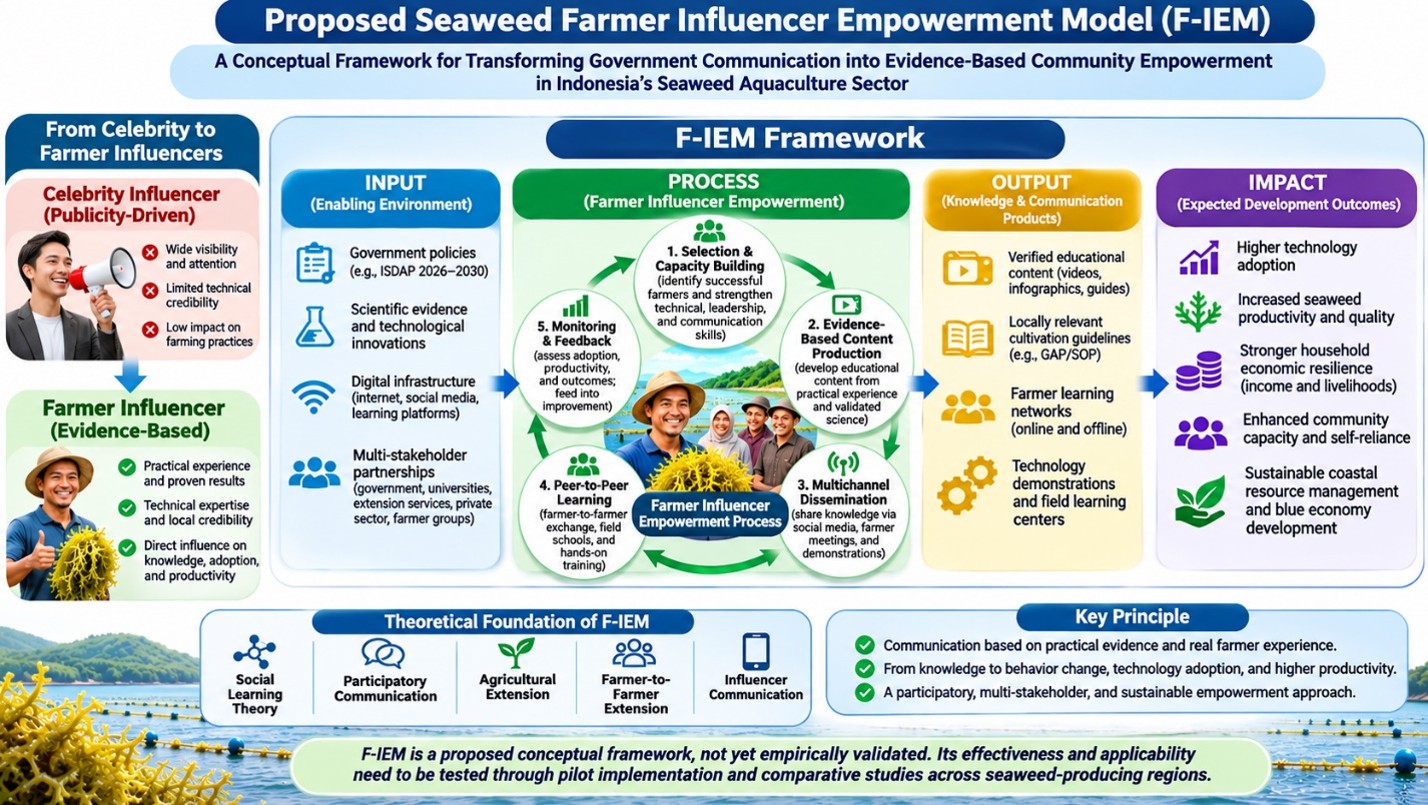
The framework integrates enabling institutional and technological inputs, five farmer influencer empowerment processes, knowledge and communication outputs, and expected sustainable development impacts. Its theoretical foundations include Social Learning Theory, Participatory Communication, Agricultural Extension, Farmer-to-Farmer Extension, and Influencer Communication.
The framework presents the proposed Seaweed Farmer Influencer Empowerment Model (F-IEM), designed to transform government communication from publicity-driven promotion into evidence-based community empowerment in Indonesia’s seaweed aquaculture sector. The model emphasizes the role of successful seaweed farmers as credible knowledge disseminators who can translate scientific research, technological innovations, and practical cultivation experience into relevant information for farming communities.
The framework consists of four interconnected components:
- Input, representing enabling government policies, scientific evidence, digital infrastructure, and multi-stakeholder partnerships;
- Process, comprising five activities: farmer influencer selection and capacity building, evidence-based content production, multichannel dissemination, peer-to-peer learning, and participatory monitoring and feedback;
- Output, covering verified educational content, locally relevant cultivation guidelines, farmer learning networks, and technology demonstrations; and
- Impact, focusing on improved technology adoption, seaweed productivity and quality, household economic resilience, community capacity, and sustainable coastal resource management.
F-IEM draws on five complementary theoretical foundations: Social Learning Theory, Participatory Communication, Agricultural Extension, Farmer-to-Farmer Extension, and Influencer Communication. Together, these perspectives explain how practical experience, technical credibility, participatory knowledge exchange, and institutional support can strengthen farmer learning and engagement. As a proposed conceptual framework, F-IEM requires empirical validation through pilot implementation and comparative studies across seaweed-producing regions.
Application of F-IEM in Indonesia’s seaweed aquaculture sector
Indonesia provides a relevant context for developing and testing F-IEM. Seaweed cultivation involves geographically dispersed coastal communities with diverse environmental, technological, and socioeconomic conditions. Sutrisno et al. (2024) identified technological gaps, limited species diversity, and competition over marine space as major challenges to sustainable seaweed aquaculture in Indonesia. These challenges highlight the need for stronger knowledge dissemination and locally appropriate technological innovation.
F-IEM could initially be implemented in established seaweed-producing regions, including Southeast Sulawesi, South Sulawesi, and East Nusa Tenggara. In Southeast Sulawesi, successful farmers in South Konawe, Bombana, North Konawe, and Central Buton could serve as farmer influencers. Their experiences could provide practical learning resources for other farming communities.
Five priority activities are proposed:
- First, Seedling development: Demonstrating the selection, preparation, and management of quality Kappaphycus alvarezii and Eucheuma denticulatum seedlings.
- Second, Cultivation technology: Sharing experiences with longline systems, improved cultivation structures, planting distances, and seed-weight optimization.
- Third, Environmental management: Promoting site suitability assessment, water-quality monitoring, and responses to environmental stress.
- Fourth, Post-harvest innovation: Demonstrating improved harvesting, drying, handling, and product-quality management.
- Fifth, Integrated aquaculture: Sharing innovations in intercropping, integrated cultivation, and sustainable coastal resource management.
Universities and research institutions should validate technical recommendations and evaluate production outcomes. Government extension officers should facilitate farmer participation, while private-sector stakeholders should provide market information, quality standards, and value-chain opportunities. Through this collaboration, F-IEM could bridge scientific research, government development programs, and practical implementation at the community level.
Research propositions and future empirical validation
As a newly proposed conceptual framework, F-IEM requires empirical validation to establish relationships among its key components. Six research propositions are proposed:
- P1: Farmer influencers’ credibility, technical expertise, and trustworthiness positively influence farmers’ trust and willingness to exchange knowledge.
- P2: Evidence-based communication improves farmers’ technical knowledge and understanding of cultivation practices.
- P3: Peer-to-peer learning increases farmers’ intention to adopt appropriate aquaculture technologies.
- P4: Institutional support and digital infrastructure strengthen knowledge dissemination through farmer influencers.
- P5: Adopting appropriate cultivation technologies improves productivity and economic performance.
- P6: Participatory monitoring and feedback strengthen the continuity and sustainability of farmer influencer networks.
These propositions can be examined through mixed-method research involving farmer surveys, interviews, field observations, and production records. Structural Equation Modeling (SEM-PLS) can assess relationships among credibility, trust, knowledge acquisition, technology adoption, and empowerment. Quasi-experimental or randomized pilot studies can further evaluate the causal effects of F-IEM interventions. Comparative studies across seaweed-producing regions can also assess how environmental, institutional, and socioeconomic conditions influence the model’s applicability.
Conclusion
Transforming government communication from celebrity-centered promotion to farmer-centered empowerment offers an opportunity to improve knowledge dissemination and innovation in Indonesia’s seaweed aquaculture sector. Celebrity influencers can raise public awareness and promote government programs. However, successful farmers offer practical credibility through their experience, demonstrated achievements, and direct relationships with farming communities.
This article proposes the Seaweed Farmer Influencer Empowerment Model (F-IEM) as a new conceptual framework integrating government policies, scientific research, farmer experience, participatory communication, and digital technology. The model connects enabling inputs, farmer empowerment processes, knowledge dissemination, and sustainable development outcomes to translate government policies into practical community benefits.
F-IEM also offers a potential mechanism to support Indonesia’s ISDAP 2026–2030 through stronger collaboration in research, innovation, technology transfer, and farmer participation. The success of seaweed development should be measured not merely by promotional activities or celebrity visibility, but by improvements in farmers’ knowledge, technology adoption, productivity, and economic independence.
Indonesia needs more than celebrities promoting seaweed cultivation. It needs successful farmers who can demonstrate, communicate, and inspire sustainable aquaculture development through practical experience and measurable achievements.